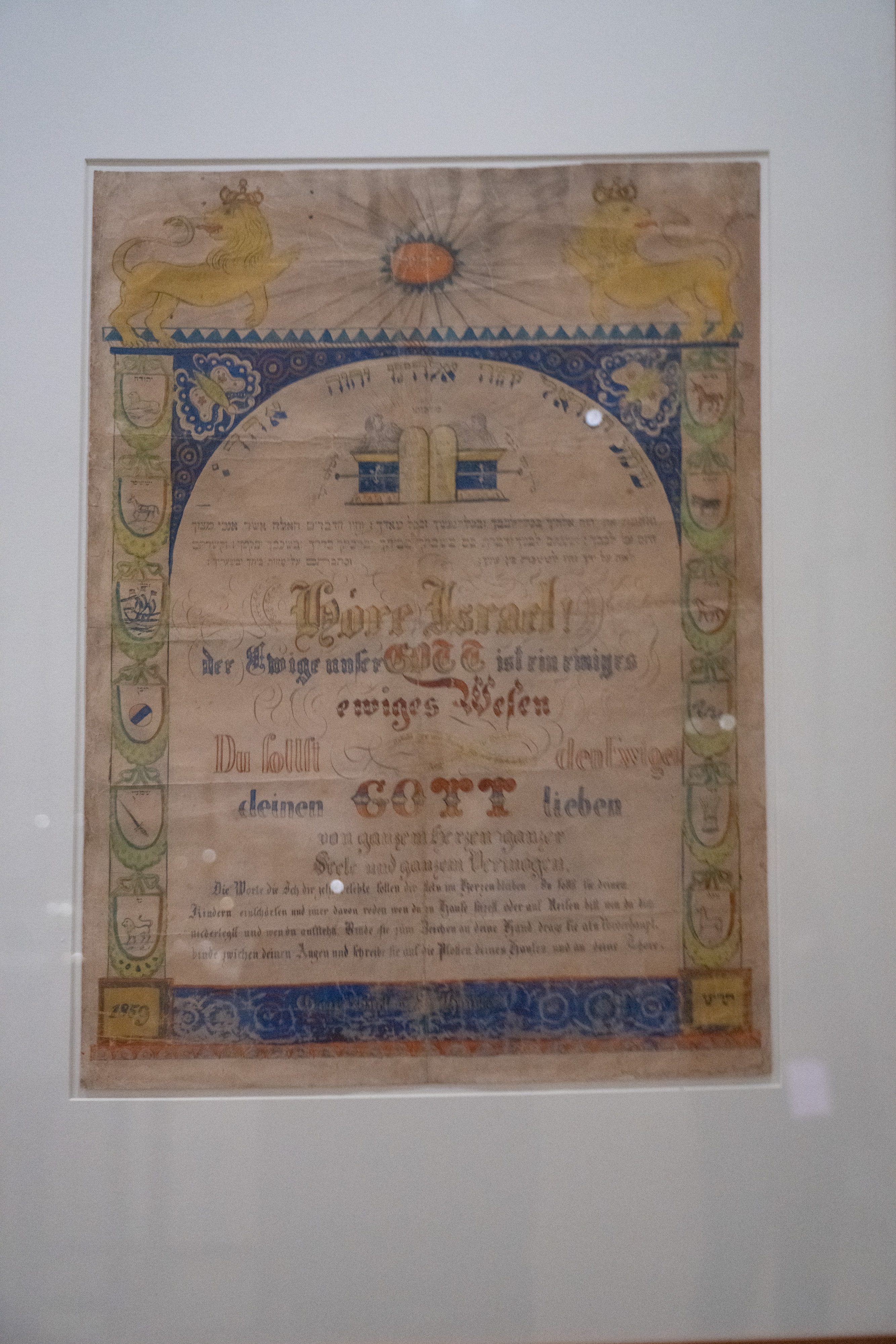
It hangs in Frankfurt behind glass. Gouache on paper, painted by hand in 1859, signed S. Thenle. Sixty-six by forty-nine centimeters. Not much larger than a folded newspaper.
It was made to hang on an eastern wall, so that whoever faced it faced Jerusalem. Crowned lions. The Ark of the Covenant painted below. On it, in Hebrew and in German, the prayer that begins Shema Yisrael. Hear, O Israel. The word for such a thing is mizrah. It means east. A direction you can hang on a wall.
But it is paper. Fragile, flammable, the first thing that should have burned.
No one knows where it hung. The record goes blank in 1859 and stays blank for a hundred and thirty years. No congregation, no synagogue, no street. A witness on paper, silent about the exact years it was needed.
A person can be raised in a Christian house, can bow to a cross, can know every hymn by heart, and still, standing before that painted Ark, feel something ancient splinter open in the chest. The first word that comes is blood. Stubborn. Unreasonable. It was there before the name was given, and no amount of Sunday school washed it out.
But watch that word. Blood is not the tradition's word. The tradition counts by lineage and covenant; it is law, not marrow. Blood is the word the murderers used. Their definition did not ask what a person believed, or what house raised him, or what he bowed to. It counted backward through the body and called the result inescapable. So the arithmetic is this, and it is unbearable: the only framework that would have claimed me without asking is theirs. To say the summons lives in the blood is to answer the mizrah in the language of the people who burned the walls it was made for.
And the pull is real anyway. That is the trap. It is a terrible and lonely thing to mourn a congregation that never knew your face. To grieve a wall you never touched. To stand half-orphaned to your own faith, holding a feeling whose only easy vocabulary is poisoned.
The paper does not ask. It accuses. You belong to this story, it says, and it does not say how.
This is all I have of how. A house on the Prinsengracht in Amsterdam, where two sisters were measured against the wallpaper and the pencil lines climbed until August 1944, then stopped. I had a birthday on that canal once. A couple of years old, thirty years later. Geography and arithmetic. One canal, two childhoods. Their lines stopped climbing. Mine didn't.
A mizrah has one job: to point east. This one reached Jerusalem, a dealer's stock in 1989, and was sold back west to Frankfurt. Behind glass it has lost its wall, its town, its east. Now it points at whoever stops in front of it.
This is survival. Not triumphant. Not loud. Paper should never outlast its people. It did. And the ones left behind carry that weight and have to find an answer that is not blood.
The wall is gone. Someone is still listening.
sha512sum -c SHA512SUMS.2969 AEB8 0A42 E021 5E66 4D93 BD9B C85E 0213 8166 415C 9171 2074 3657 B386 AF51.ots file proves that SHA512SUMS existed at or before the Bitcoin block timestamp below.