© 2026 Bryan R. Hinton
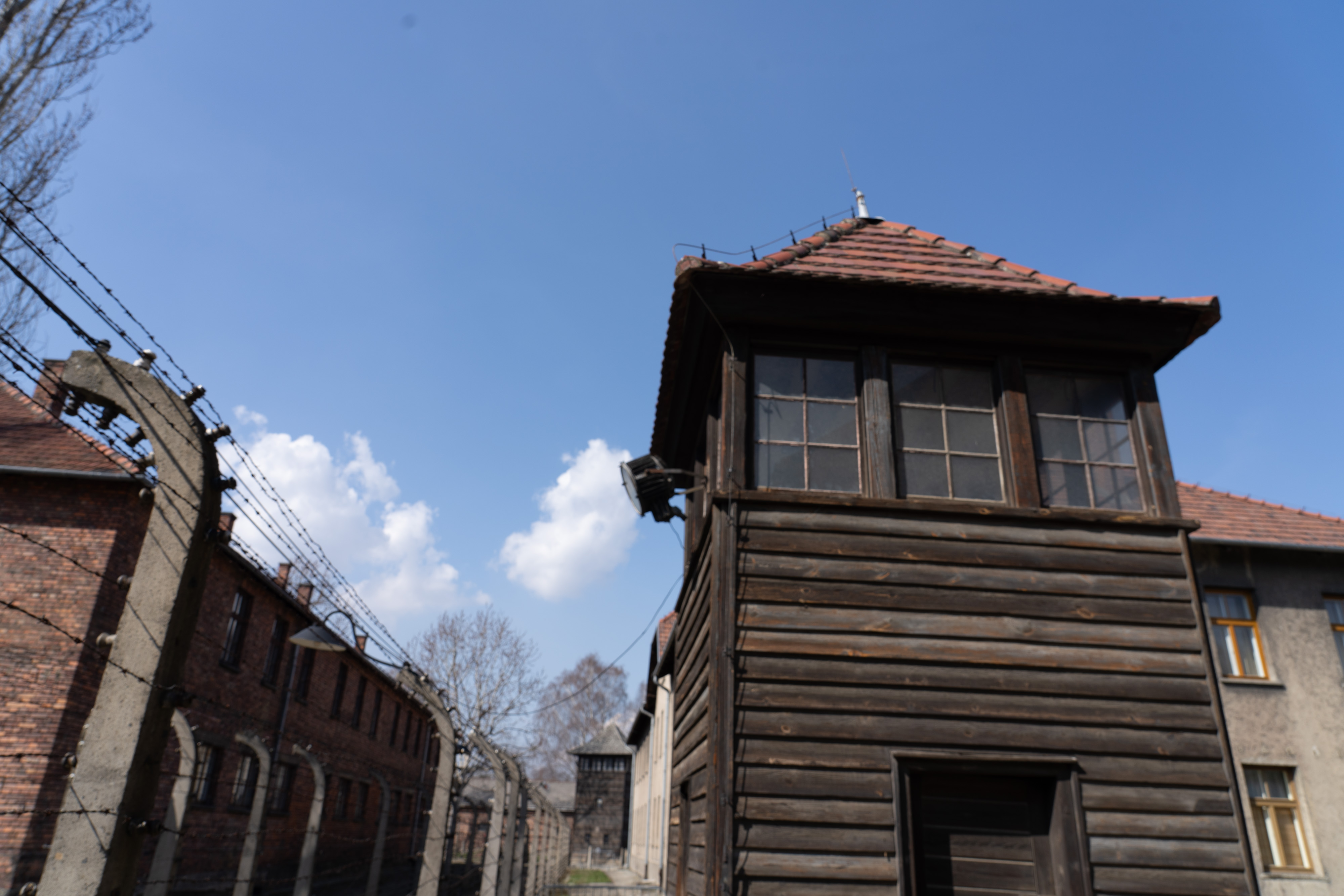
She arrived under a tower like this one, three kilometres away at Birkenau. She left as Reg. A 105, folio 9.
Auschwitz I was surrounded by a double barbed-wire fence punctuated by guard towers at regular intervals. The towers stood on the outer perimeter; the fence was electrified at high voltage. Along the fence, on the camp side, ran a gravelled strip, the "neutral zone". Camp regulations, corroborated by survivor testimony, held that guards in the towers could shoot any prisoner who entered that strip without warning. Their function was custody: to ensure that the people inside could not leave until the state had decided how they would.
flyioOn 3 September 1944, the last transport from the Westerbork transit camp to Auschwitz departed the Netherlands. It arrived at the new ramp inside Auschwitz II–Birkenau on the night of 5–6 September, after two and a half days in locked cattle wagons. Of the 1,019 Jews on the manifest, four were Franks. They appeared in sequence: Margot at 306, Otto at 307, Edith at 308, Annelies Marie at 309. By the Anne Frank House's reconstruction from the transport list and the camp number series, 648 people from the transport were registered into the camp administration after selection; 371 were sent directly to the gas chambers. The women remained at Auschwitz II–Birkenau. The men were taken to Auschwitz I, about three kilometres away; the distance and the camp's known procedures suggest they made the journey on foot. On 30 October, Margot and Anne were selected for transfer to Bergen-Belsen; the transport departed the night of 1 November and arrived on 3 November. The dates are reconstructed from survivors' letters and interviews; no transport list naming the sisters survives. Edith was left behind at Auschwitz II–Birkenau. According to the account of Rosa de Winter‑Levy, she died there in the infirmary on 6 January 1945; neither the place nor the date is confirmed by any camp record.
The Westerbork camp kept its own register. Her entry is on page 40. The pink card below is an extract citing it, preserved in her death file; the oldest documents in that file date from April 1951, so the card was most likely made in the course of postwar processing rather than at the camp. Transport: 3-9-44. Naam: FRANK. Voornamen: Annelies, M. Geboren: 12-6-29. Adres: Merwedeplein 37, Asd. It is among the last documents in the state's custody of her to record the street where she lived.

Nationaal Archief, Den Haag · 2.09.34.02, inv.nr. 539 · public domain
Bergen-Belsen maintained a prisoner registration system, so Margot and Anne would have been registered upon arrival and assigned new numbers, as was standard practice. But shortly before British forces liberated the camp on 15 April 1945, the SS burned the prisoner registration records. The numbers Anne and Margot were assigned at Bergen-Belsen are not known; neither are their Auschwitz numbers. The women of their transport were tattooed in a numbered series, but no surviving record ties either sister to a number within it. After the Westerbork transport list of 3 September 1944, no surviving document names them at all. According to eyewitness accounts and the postwar historical consensus, they died at Bergen-Belsen of typhus, probably in February 1945. The dating rests on those witness statements, on the 7 February 1945 transport list to Raguhn (which fixes the departure of witnesses who had seen them ill), on the receipt of a Red Cross parcel in late January 1945, and on the ordinary course of the disease.
For six years, the paperwork caught up slowly. The two oldest documents in her death file are forms dated 6 April 1951, in which the Commissie tot het doen van aangifte van overlijden van vermisten, the Committee for the Reporting of the Decease of Missing Persons (created under the law of 2 June 1949), wrote to the Dutch Red Cross and to the Amsterdam civil registrar to ask what was known. The Red Cross filed the Committee's request against its own record: "dossier N.R.K. 117266. Cf. concl. RK † 31 Maart 1945 te Bergen Belsen / Dld." Conclusion: died no later than 31 March 1945 at Bergen-Belsen. The Amsterdam civil registrar confirmed that no death certificate had been issued. Six years after Anne Frank's death, the municipal record said only that she had vanished and had never been declared dead.
On 7 May 1954, Johannes Kleiman, Otto Frank's colleague and one of the helpers who had hidden the Franks, wrote to the Committee as Otto's authorized representative, asking that the declarations for Margot and Anne be processed; Otto needed them to have a certificate of inheritance drawn up. The Committee acknowledged receipt on 4 June. The declaration itself was issued on 29 July 1954, in The Hague. It is the document reproduced below.

Commissie tot het doen van aangifte van overlijden van vermisten · Nationaal Archief 2.09.34.02, inv.nr. 539
The declaration is a typed form on light paper, numbered No. 107,658. Stamped at the top: AFSCHRIFT — copy. The printed Dutch is dense with legal procedure: Krachtens art. 2 van de Wet van 2 Juni 1949 (Stbl. No. J 227) doe ik U hierbij aangifte van het overlijden van de hieronder vermelde vermiste. By virtue of article 2 of the Law of 2 June 1949, I hereby declare the death of the missing person named below. The filled-in carbon strikes are faint: Op een en dertig Maart negentienhonderd vijf en veertig is in Bergen-Belsen in Duitsland overleden: Frank, Annelies Marie. The date is written in longhand Dutch, een en dertig Maart, the certainty the facts didn't support, spelled out word by word.
The form was sent to the Amsterdam civil registrar. Three months later, on 29 October 1954, the registrar entered the death in the municipal register in faint purple hand at the lower right: Reg. A/105. Fol. 9. Initialled and filed.

Cites overlijdensakte · Burgerlijke Stand Amsterdam · Reg. A 105, Fol. 9 · d.d. 29-10-1954
The archiefkaart is Amsterdam's internal reference card for that registry entry. Printed fields in Dutch: Naam, Voornamen, Geboren op, Overleden op, Overlijdensakte opgemaakt, Bijzonderheden. The handwriting fills them in. Born 12 June 1929. Died 31 March 1945. Filed at Amsterdam on 29-10-54. Bijzonderheden (particulars): blank.
The working card that produced the date survives in the Dutch Red Cross Information Bureau's persoonsdossier on Anne Frank. It is pencil and ink, stamped 22 January 1952, a year after the statement of Lien (Lientje) Rebling-Brilleslijper, who had been imprisoned with Anne and Margot at Bergen-Belsen. In the clerk's hand at the bottom, boxed off from the rest, is the conclusion: Overleden te Bergen-Belsen niet eerder dan op 1.3.45 en uiterlijk 31.3.45. No earlier than 1 March, no later than 31 March.

Nederlandse Rode Kruis, Informatiebureau · Nationaal Archief 2.19.288, inv.nr. 101677 · vervroegd openbaar gemaakt oktober 2023
The date 31 March 1945 is a bureaucratic default. It was the Committee's standard practice to date unknown deaths at the last day of the assumed month when a witness statement could establish the month. The witness statement was Brilleslijper's, given to the Dutch Red Cross on 22 January 1951. She said Anne and Margot died "around March 1945." She had put it differently elsewhere: to Otto Frank in November 1945 (the end of February or the beginning of March), and in a memoir written at his request in April 1951, where the end comes in February. The Committee picked March 31. No one then knew, and no one now knows, when Anne Frank actually died.
Her name also appears on a typed list. Lijst No. 1908. Every entry on the page is a Frank. She is fifth down: Annelies Marie, Frankfurt am Main, 12-6-1929, Bergen-Belsen, 31-3-1945. Six rows below her: Aron Moses Edward, Rotterdam, 7-8-1910, Polen, 31-3-1944. Place of death: Poland. The last day of March. Almost certainly the same administrative default, one year earlier. Near the top: Andries, Tiel, 4-3-1914, Omgeving van Auschwitz, 30-4-1943 (surroundings of Auschwitz, the last day of April). The list is one of many. This sheet was typed on 29 April 1959. It covers the letter A through the start of B.

Typed list of Dutch concentration-camp victims · d.d. 29-4-1959
Sources
Transport list: numbers 306, 307, 308, 309 (Margot, Otto, Edith, Anne Frank). Nederlandse Rode Kruis, Den Haag (war archive now held by the Nationaal Archief): Transportlijst Westerbork–Auschwitz, 3 september 1944 (inv. nr. 1066, Blatt 7). Otto Frank is listed at number 307 as "Frank Otto 12.5.89 Kaufman." Cited via the scholarly apparatus of the Anne Frank House Knowledge Base: Deportation to Auschwitz-Birkenau. This was the last transport from Westerbork to Auschwitz; larger transports left afterwards for other destinations, including transport XXIV/7 to Theresienstadt on 4 September 1944 with over 2,000 people.
Auschwitz-Birkenau: selection at the ramp, separation of men and women; arrival confirmed on the night of Tuesday 5 to Wednesday 6 September 1944. By the Anne Frank House's reconstruction from the transport list and camp number series, 648 of the 1,019 persons (399 men, 249 women) entered the camp administration and 371 were killed on arrival. Danuta Czech's Kalendarium der Ereignisse im Konzentrationslager Auschwitz-Birkenau gives the older standard figures for this transport: 470 registered (258 men, 212 women) and 549 killed. Anne Frank House Knowledge Base: Selections upon arrival at Auschwitz-Birkenau; Auschwitz I: the men in the Stammlager.
The new internal Birkenau ramp (Neue Rampe), operational from May 1944. Muzeum Auschwitz-Birkenau (Oświęcim): The unloading ramps and selections.
Auschwitz I: double barbed-wire fence, watchtowers, high-voltage electrification, and the "neutral zone" where prisoners could be shot. Wacław Długoborski, Franciszek Piper (eds.), Auschwitz 1940–1945. Central issues in the history of the camp, Oświęcim: Auschwitz-Birkenau State Museum, 2000, vol. I, and survivor testimonies. Photographs of the preserved fence system: Muzeum Auschwitz-Birkenau: Watchtowers and fence system (Former Auschwitz I site).
Otto Frank's transfer to Auschwitz I. The Anne Frank House states that the men were taken to Auschwitz I, about three kilometres away; the camp's layout and standard practice suggest they made the journey on foot. No document explicitly records the mode of travel for this group. Anne Frank House Knowledge Base: Auschwitz I: the men in the Stammlager.
Transfer of Margot and Anne to Bergen-Belsen (selected 30 October 1944; transport departed 1 November; arrived 3 November). Dates reconstructed from survivor correspondence and interviews (letters of Margot Rosenthal and Nanette Blitz to Otto Frank; Willy Lindwer, De laatste zeven maanden, 1988; synthesis in Bas von Benda-Beckmann, Na het Achterhuis, 2020); no transport list naming Anne or Margot survives. Anne Frank House Knowledge Base: Journey to Bergen-Belsen; Arrival at Bergen-Belsen.
Registration at Bergen-Belsen. Bergen-Belsen maintained a prisoner registration system; arriving prisoners were routinely registered and assigned numbers. The SS burned these records before liberation, so the specific registration of Anne and Margot is an inference from standard camp procedure, not a documented fact. Gedenkstätte Bergen-Belsen (Lower Saxony): Register of Names; The Dead of the Bergen-Belsen Concentration Camp.
Death of Anne and Margot Frank at Bergen-Belsen. No camp record documents their deaths. The place and approximate date rest on eyewitness accounts (Brilleslijper, Blitz, Van Amerongen, and others) and subsequent historical analysis. The 31 March 1945 administrative default and the February 1945 revision are discussed in Anne Frank House: Sources for the date of death of Anne and Margot Frank in Bergen-Belsen (2015): eyewitness statements, the Bergen-Belsen–Raguhn transport list of 7 February 1945 (ITS, Bad Arolsen), a Red Cross parcel receipt of c. 23 January 1945, and the clinical course of typhus. Anne Frank House Knowledge Base: Death of Anne and Margot Frank. Official date based on Lientje Brilleslijper's 22 January 1951 statement to the Nederlandse Rode Kruis (file 117266, cartotheekkaartje of the Afwikkelingsbureau Concentratiekampen); the same Anne Frank House document records her earlier statements of 11 November 1945 and 5 April 1951, and notes that Otto Frank needed the declarations for a certificate of inheritance. Official date set by the Commissie tot het doen van aangifte van overlijden van vermisten, Dutch Ministry of Justice. Underlying archival research: Raymund Schütz, Vermoedelijk op transport (Master's thesis, Archival Science, Universiteit Leiden Instituut Geschiedenis, 2010).
Edith Frank-Holländer: death at Auschwitz II–Birkenau, 6 January 1945. The place and date rest solely on the account of Rosa de Winter-Levy; no camp record confirms them. See also the Anne Frank House Knowledge Base.
Westerbork transit camp: site memorial and documentation. Herinneringscentrum Kamp Westerbork (Hooghalen): kampwesterbork.nl.
Westerbork records as archived in the International Tracing Service. Arolsen Archives (Bad Arolsen, UNESCO Memory of the World): Westerbork Assembly and Transit Camp records (DE ITS 1.1.46).
Anne Frank's Jewish Council index card (Amsterdam). Arolsen Archives: Index card from the Jewish Council card file in Amsterdam — Annelies Maria Frank.
Westerborkregister: extract card for Annelies Marie Frank, transport of 3 September 1944. Pink preprinted card citing the Westerbork register (Blz. 40) and recording surname (Frank), given names (Annelies, M.), date of birth (12-6-29), home address (Merwedeplein 37, Amsterdam), and transport date (3-9-44). Preserved in Anne Frank's overlijdensdossier at the Committee; the card's own production date is not established. The oldest documents in the dossier are the Committee's forms of 6 April 1951, so the card was most likely made in the course of postwar processing rather than at the camp. Nationaal Archief, Den Haag: Ministerie van Justitie / Commissie tot het doen van aangifte van overlijden van vermisten, toegangsnummer 2.09.34.02, inv.nr. 539. Publicly accessible; no copyright restrictions ("Volledig openbaar. Er zijn geen beperkingen krachtens het auteursrecht").
Aangifte van overlijden van vermiste (declaration of death of a missing person): Annelies Marie Frank, No. 107,658. Issued in 's-Gravenhage (The Hague) on 29 July 1954 by the Commissie tot het doen van aangifte van overlijden van vermisten (Ministry of Justice), a body established under the Wet van 2 Juni 1949 (Stbl. No. J 227) to produce paper closure for Dutch residents missing from the war. Entered by the Amsterdam civil registrar on 29 October 1954 in the Register van Overlijden, Register A 105, Folio 9. Nationaal Archief, Den Haag: toegangsnummer 2.09.34.02, inv.nr. 539. Publicly accessible; no copyright restrictions. The same document is catalogued at Yad Vashem, Record Group O.41, item 5222601. The full chronology of the Committee's handling of Anne Frank's case (6 April 1951 inquiries to the Dutch Red Cross and Amsterdam civil registrar; Kleiman's 7 May 1954 letter on behalf of Otto Frank; the Committee's 4 June 1954 acknowledgment; the 29 July 1954 declaration; the 29 October 1954 Amsterdam registration) is set out in the Nationaal Archief's public exhibition page, Het overlijden van Anne Frank wordt vastgesteld.
Cartotheekkaartje: NRK Information Bureau conclusion card, stamped 22 January 1952. Handwritten index card summarising Brilleslijper's statement and establishing the administrative bracket for the date of death: Overleden te Bergen-Belsen niet eerder dan op 1.3.45 en uiterlijk 31.3.45. References NRK Information Bureau Report 6/XIV No. 102, Opsporing Joodse Personen (Search for Jewish Persons). Preserved in Anne Frank's persoonsdossier at the Dutch Red Cross Information Bureau. Nationaal Archief, Den Haag: Het Nederlandse Rode Kruis — Informatiebureau: Persoonsdossiers, toegangsnummer 2.19.288, inv.nr. 101677 (persoonsdossier Anne Frank, vervroegd openbaar gemaakt / released ahead of schedule, October 2023).
Archiefkaart: Frank, Annelies Marie. Amsterdam civil registry reference card citing the overlijdensakte at Register A 105, Folio 9, d.d. 29-10-1954. The Stadsarchief Amsterdam holds archief- and persoonskaarten under toegangsnummer 30238, and cards of deceased persons are publicly accessible online at archief.amsterdam. The archival provenance of the specific scan reproduced above is not established here.
Typed concentration-camp victim list reproduced above. Header: CONCENTRATIEKAMP — Lijst No. 1908. Column headers: Naam / Voornaam / Plaats en datum van geboorte / Plaats en datum van overlijden. Page 14 of a larger series; typed footer dated 29 April 1959, with bilingual Dutch-French labels par typ and par contr. The format is consistent with Nederlandse Rode Kruis compilations from the postwar Afwikkelingsbureau Concentratiekampen, but the archival provenance of the scan itself is not established here.
sha512sum -c SHA512SUMS.2969 AEB8 0A42 E021 5E66 4D93 BD9B C85E 0213 8166 415C 9171 2074 3657 B386 AF51.ots file proves that SHA512SUMS existed at or before the Bitcoin block timestamp below.